
Key Stage 3 subjects
At Key Stage 3 the school offers a broad and balanced curriculum, with students studying Maths, English, Science, Languages, Geography, History, PE, Music, Design & Technology, Art, Computer Science, Drama, RE and Life Skills (including PSHE & Citizenship).
Art & Design
Curriculum Intent – what is Greenford High School aiming to achieve through its Art curriculum?
• To enable students to develop an understanding and awareness of the world around them by questioning their surroundings, looking deeply and opening their eyes to fresh perspectives
• To develop an awareness of health and safety within an art studio environment and to take responsibility for managing the materials they use
• To develop and apply art skills such as drawing, painting and sculpting and artistic techniques to communicate an idea and analyse the effectiveness of own art work
• To be creative and develop their ability to problem solve, think academically, emotionally, physically and spiritually. They will learn to adopt resilience and focus in applying their technical skills to projects that develop their self-expression
• To respond imaginatively to artist and thematic research and use knowledge of key artists and cultures to inspire their art work. Students develop an understanding of the historical and cultural development of art forms and are taught to evaluate and analyse artworks using subject-specific vocabulary
• To plan and develop meaningful responses for their art work that realises intentions and demonstrates an understanding of visual language
• To display creative expression which leads to improved well-being, and support their study experience. The study of other cultures through Art has strong links with Religious Education, History, English, and Media.
All students at Greenford High School study Art and Design at Key Stage Three. Our Art department aims to ensure that all students:
● Develop creative ideas and learn to record their experiences.
● Become proficient in drawing, painting, self-expression, sculpture and other art, craft and design techniques.
● Learn about great artists, art-forms, architecture, crafts, and designers, developing a sound understanding of the historical and cultural backgrounds that inspired them.
Pupils learn how to develop their creativity and ideas, and increase proficiency in their execution. They should develop a critical understanding of artists, architects and designers, expressing reasoned judgements that can inform their own work.
Year 7 Art
Unit 1: Introduction to Art: Students are introduced to the formal elements by exploring tone, mark-making, colour theory, abstract expressionism- responding to music and the work of Kandinsky, painting, texture and line through observational drawings of natural and man-made forms using graphite pencils, coloured pencils and watercolour, ink and oil pastels. Students develop their understanding of tone, form, abstraction, colour theory and explore a range of expressive drawing and painting techniques. Students develop their skills in both traditional and experimental drawing techniques, painting, abstracting forms, mark-making & self-expression.
Unit 2: Artist Research: Visual Analysis through artists work, using the Formal Elements. Students explore artists such as Paul Cezanne, Van Gogh, Sonia Delaunay and Bridget Riley.
Year 8 Art
Unit 1: Day of The Dead: Students explore the ‘Day of the Dead’ Festival, they look at the history, symbolism and meaning behind this festival. They will explore the symbolism and further develop their artist skills through the medium of Printmaking, sgraffito and 3D design.
Unit 2: Perspective Drawing: Students learn to draw in perspective using accurate technical skills, from 1 point perspective to 4 point perspective. Students later move on to study the work of LS Lowry and Stephen Wiltshire using their style of drawings and paintings to inspire their own artwork. Students use skills developed in subjects like Maths and Design Technology in this project.
Year 9 art
Unit 1: Tonal Portrait: In this unit, students build upon the formal elements of art introduced in Year 7, applying them within the context of portraiture. They explore the historical and artistic tradition of portrait drawing, with a focus on developing skills in line, tone, and proportion. Additionally, students are introduced to the grid method as a tool for accurately enlarging and reducing images, enhancing their observational drawing techniques and precision.
Unit 2: Grid Portrait: In this unit Students explore the grid based technique used by artist Chuck Close, who is well known for his large - scale photorealistic portraits. We look at how he builds his images box by box, using the grid method to break down using the grid method to break down complex portraits into manageable sections. Students will use this enlargement to create their own portraits, focusing on one square at a time to develop a pixelated effect. Alongside this, they will apply colour theory to guide their choices in each square, considering tone, hue, and contrast to bring their final piece together.
Unit 3 : Consumerism
In Year 9, students develop an in-depth study of consumerism through either lino printing or photography. Consumerism explores how advertising, branding, mass production and social media influence the way people think, behave and define identity. Students learn how artists use visual language to challenge these ideas. Inspired by Barbara Kruger, they explore bold text, slogans and graphic composition to question power and persuasion. Käthe Kollwitz informs emotional depth, symbolism and social commentary, while Banksy introduces satire, protest and street-art aesthetics. Shepard Fairey supports understanding of propaganda-style imagery, repetition and strong visual impact. In KS3, students adapt these influences by developing personal responses using photographic composition, layered imagery, printmaking techniques and critical annotation. They experiment with contrast, scale and message to communicate opinions about modern consumer culture. This project builds visual literacy, encourages independent thinking and prepares students for conceptual approaches used in KS4 Art and Photography.
Progression Routes
Students can opt to continue to study Art or Photography in KS4 from year 8 onwards. Both Photography and Fine Art are also offered at A-Level. Successful study of a creative course is valued by both universities and employers with students gaining many transferable skills. Art students develop an excellent cultural awareness, develop their understanding of visual language, self-expression, observational, critical, analytical and research skills, including the ability to solve problems creatively, articulate their ideas and work well both independently and in groups.
ComputER Science
Computing and IT Curriculum Intent – Greenford High School
At Greenford High School, our Computing and IT curriculum aims to equip students with the knowledge, skills, and mindset needed to thrive in an increasingly digital world.
- We develop students’ understanding of key computational concepts and their ability to use technology safely, effectively, and responsibly.
- Our curriculum fosters problem-solving, analytical thinking, and creativity—helping students become confident users and creators of digital solutions.
- At Key Stage 3, students build a strong foundation in computer science and digital literacy. They learn programming, computational thinking, and how to design digital products for real-world audiences, while also being taught to stay safe online.
- The curriculum encourages resilience, logical thinking, and the ability to learn from mistakes.
- At Key Stage 4, students build on this foundation to develop the mindset of a computer scientist—deepening their understanding of computing systems, programming, and the broader implications of technology.
- Across all key stages, students gain transferable digital skills and an appreciation of how technology is developed and continually evolving.
Our Key Stage 3 Computing curriculum has Computer Science at its core as well as elements of digital technologies. Pupils develop computational thinking skills and create algorithms to solve real life problems whilst also developing their computer programming skills. Students benefit from learning how to use a range of digital technologies so that they can develop digital products appropriate to selected audiences. Finally, throughout their time in Key Stage 3 students are taught how to use digital technologies in a safe and responsible manner.
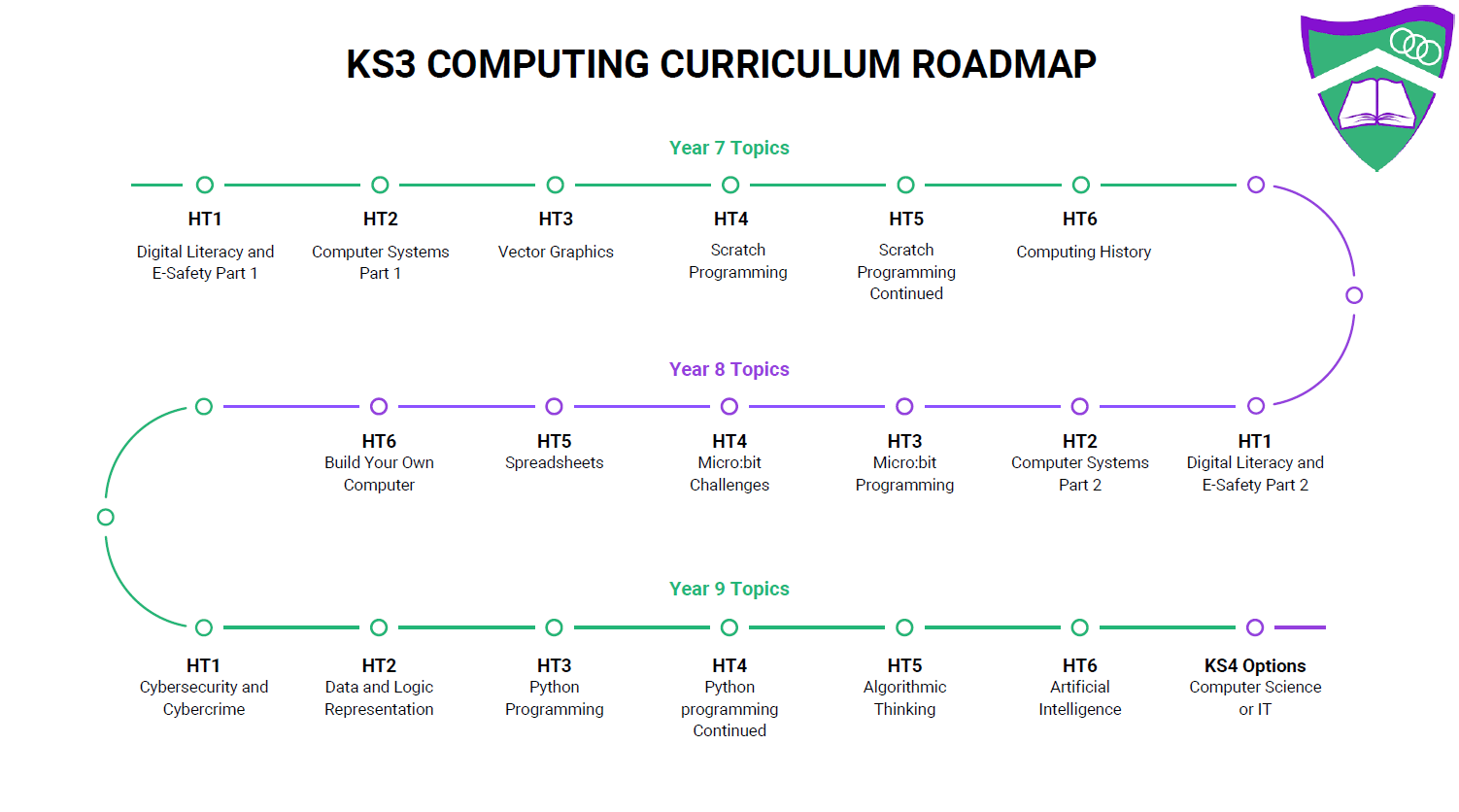
Year 7
|
Digital Literacy and E-Safety Part 1 |
This unit equips students with essential digital literacy skills to navigate the modern technological landscape safely and efficiently. It fosters responsible digital citizenship by enhancing students' ability to manage files, use social media securely, protect personal and sensitive data, and communicate effectively via email. |
|
Computer Systems Part 1 |
This unit introduces students to fundamental computer science concepts, focusing on the structure and function of computer systems. It provides a strong foundation in understanding how computers operate, the role of embedded systems, and how data flows within a system. |
|
Vector Graphics |
This unit introduces students to the principles and applications of vector graphics, equipping them with the skills to create scalable and high-quality digital artwork. Through hands-on practice and project-based learning, students will develop their ability to design and manipulate vector-based images. |
|
Scratch Programming |
This unit introduces students to fundamental programming concepts through Scratch, a visual, block-based programming language. It develops problem-solving skills and logical thinking by guiding students through key programming structures, preparing them for more advanced coding concepts. |
|
Scratch Programming Continued |
Building on previous Scratch programming concepts, this unit introduces more advanced programming structures, enhancing students’ ability to create dynamic and interactive projects. By exploring operators, iteration, and storytelling through animation, students will develop logical thinking and creativity in coding. |
|
History of Computing |
This unit allows students to consolidate their programming knowledge by designing and developing a Scratch project that demonstrates creativity, logical thinking, and problem-solving skills. It encourages independent learning and the application of key coding concepts in a structured project. |
Year 8
|
Digital Literacy and E-Safety Part 2 |
This unit builds on foundational digital literacy and e-safety skills, focusing on responsible online behaviour, digital communication, and the impact of social media. It encourages students to think critically about their digital footprint, online interactions, and personal security. |
|
Computer Systems Part 2 |
This unit extends students' knowledge of computer systems by exploring how computers process and store data. It introduces binary, the fundamental language of computers, and develops problem-solving skills through binary arithmetic. |
|
Micro:bit Programming |
This unit introduces students to the fundamentals of programming using the Micro:bit. Students will develop a foundational understanding of how to design, code, and debug programs that utilize the Micro:bit’s various inputs, outputs, and sensors. Through a series of practical, hands-on lessons, they will learn essential programming concepts such as variables, conditional logic, loops, and functions. |
|
Micro:bit Challenges |
This unit enhances students' Micro:bit skills through challenge-based projects. They will design, code, and test a sports counter and a timer, applying concepts like variables, inputs, outputs, and conditional logic. By the end, students will confidently create functional Micro:bit programs. |
|
Spreadsheets |
This unit introduces students to the fundamental concepts of spreadsheet software, focusing on data organization, analysis, and manipulation. It equips students with essential skills to create and manage spreadsheets, and to use formulas for efficient data processing. |
|
Build your Own Computer |
This unit focuses on using spreadsheet software to manage and calculate the costs of building a computer, helping students develop financial literacy alongside their technical understanding of computer components. Students will learn to use spreadsheets to track, calculate, and analyze the costs of various computer parts, creating a detailed budget for the project. |
Year 9
|
Cybersecurity and Cybercrime |
This unit on Cybersecurity is designed to provide students with foundational knowledge and practical skills to understand, identify, and mitigate common cybersecurity threats. In an increasingly digital world, it is crucial for students to recognize the importance of securing personal data, avoiding online threats, and understanding legal and ethical responsibilities related to digital information. |
|
Data and Logic Representation |
This unit provides students with an understanding of how various types of data—text, images, and sound—are represented and processed in computers. By exploring the underlying principles of data encoding and computer logic, students will develop an appreciation for the fundamental building blocks of digital systems and the role of logic in data processing. |
|
Python Programming |
This unit introduces learners to the fundamentals of Python. Students will develop core skills in writing and debugging code, using variables, data types, inputs, outputs, and basic control structures such as selection and iteration. Through practical tasks and small projects, learners will build a solid foundation in computational thinking, problem-solving, and algorithm design. By the end of the unit, students will be able to write simple Python programs and understand how programming can be applied to solve real-world problems. |
|
Python Programming Continued |
This unit builds on the foundational knowledge from the previous Python Programming unit, introducing learners to more advanced programming concepts and techniques. Students will explore the use of functions, data structures such as lists and dictionaries, file handling, and modular code design. By engaging in extended programming tasks and mini-projects, learners will deepen their coding skills and prepare for higher-level programming or coursework projects. |
|
Algorithmic Thinking |
This unit introduces students to the core principles of algorithmic thinking, enabling them to approach problems in a structured and logical way. By understanding algorithms and their implementation, students will develop the skills to break down complex problems into smaller, manageable steps, which can then be solved efficiently through programming. |
|
Artificial Intelligence |
This unit introduces students to the fundamentals of Artificial Intelligence (AI), providing an overview of its key concepts, applications, and ethical implications. Students will explore various AI techniques, such as machine learning and neural networks, and learn how these technologies are used to solve complex problems in a range of fields. |
PROGRESSION ROUTES
Students can go on to study Computer Science GCSE or a Level 2 course in Information Technology. Both are popular options among KS4 students.
Design and Technology
Curriculum Intent - What is Greenford High School aiming to achieve through its Design & Technology curriculum?
• To build up creativity, problem solving, planning, practical and evaluation skills to become independent and resourceful.
• To develop Health and Safety awareness in their working environment and surroundings to keep students safe.
• To develop the students' understanding of the huge, life-changing role and impact a designer can have through the use of real world problems and value what is ‘good design’ and how it will impact their future lives.
• To foster a culture of ‘design critique’ to produce quality outcomes via peer and group work, respecting other students’ opinions.
• To become moral, social, responsible designers and design to aid comfort, transport, physical needs, communication, health and also for aesthetic reasons to make a positive contribution to society.
• To develop resilience when understanding the developments in design and technology, its impact and effect of products on individuals, society and the environment, and the responsibilities of designers, engineers and technologists.
• To learn the basics of nutrition and a healthy balanced diet, understand where the food we eat comes from, be able to make informed healthy choices and enjoy the cultural diversity of dishes that International cuisine offers.
• To acquire relevant knowledge from other subjects and apply them to produce successful outcomes.
• To prepare pupils for the next stage of their education, future pathways and careers through developing the skills and attributes required for success both at school and in the workplace.
YEAR 7
Product Design/Woodworking: Chocolate Mould
In DT, students are introduced to the fundamentals of woodworking. In the workshop, they expand their knowledge and comprehension of safety and hazards. An overview of specialised tools that they may use on their own. a variety of plastic-working production techniques, including vacuum forming, that they employ to produce their final product. Students are taught how to use tools on their own and are exposed to low-risk machinery. Students learn about the characteristics and composition of wood and polymers. This is a three-week project.
Food: Healthy Eating and Hygiene/Safety in the Kitchen
The eat-well plate and fundamental nutrition will be used to introduce students to healthy eating. They'll discover how crucial it is to practise safety and hygiene in the kitchen. Students will become comfortable and competent in a variety of culinary techniques. Pupils will have established basic skills in chopping and cutting techniques safely. Adopting a procedure for washing up and adhering to safety regulations in the kitchen environment. By evaluating and analysing the food items they produce, they will hone and utilise their sensory abilities. The project will last for three weeks.
Collaborative work: STEM Challenges
A collaborative learning experience is provided to students through the STEM challenges. In doing so, Students practise teamwork from the outset, a skill that is directly applicable to the industrial setting. A competition-style project lasting three weeks. Each student receives a grade based on their amount of effort, teamwork, and skill development. They conduct investigations on marble runs, bridges, and the forces at work. Students develop model making skills to create a workable product that will be tested and presented to the class. Learners acquire skills related to group responsibility, organisation, teamwork, time management, and science cross-curricular learning in addition to improving presentational abilities.
Textiles: Bookmarks
Students will learn about the fundamentals of fabrics and textiles, as well as safety precautions. Students will be able to follow the primary concepts in order to develop a designed product that is appropriate to their end user. Students are exposed to multiple embroidery stitching techniques typically employed in the industry. Students will gain more experience working with fabrics and materials. By the end of the project, students will have created a bookmark to demonstrate their design techniques and hand stitching.
YEAR 8
Food: Dietary Needs
In this project, students will learn to create and develop different food products for a variety of dietary needs as well as gain an understanding of sustainable issues in food (agriculture, horticulture, seasonally grown food and Fair-trade). Students will conduct user-centred design by investigating the different dietary needs of people as well as looking at the nutritional value of different food groups/types. All students will develop their skills in the kitchen by taking part in a range of focused practical tasks (FPT). The recipes from the FPT can later be redesigned, developed and adapted to make them better refined for the user’s dietary needs. The students will further test and evaluate these recipes to improve their sustainable aspects and to see if they are commercially viable.
Technology - Eco Homes Sustainable CAD Designs
The pupils get introduced to computer-aided design. In addition to studying the advantages and uses of computer-aided design (CAD), students will become proficient with 2D design tools. Students will also be required to visually model items using the Sketchup application in order to aid in their conceptualisation of three-dimensional products. Students will be able to generate elaborate virtual drawings, digital presentations, 3-D virtual modelling, and more with the practice of basic computer-based tool skills. Students develop a skill of visually communicating design concepts. This is a three-week project.
Textiles: Inclusive Soft toy and Pewter keychain
Students will develop their skills from year 7, to further challenge their knowledge and skills in textiles. Students are informed of user centred designing. Students will be able to analyse key elements to incorporate in their design when investigating their end user of the visually impaired and resolving gaps in the toy industry. Students will build and develop their investigation and research of their user as well as understanding inclusive design, adapting products to the users needs. Students build on product analysis and biomimicry themes. Students should be able to use the different strategies of design investigation to help design their product. Students will have refined skills of embroidery and will progress in producing three-dimensional textile products. Students should learn how to work safely with metals, including understanding the pewter casting process, to be able to use metal tools, low-risk machines, and refine metal with relevant polishing techniques.
YEAR 9
Food: Nutrition and Food Science
In this project, students will learn how to manufacture and develop a variety of food products to fulfil the dietary and nutritional needs of different age groups. Students will learn about macro and micronutrients, food sources, and their health advantages. Students will comprehend chemistry changes in food science, such as gelatinisation and aeration. All students will develop their cooking skills by engaging in a variety of focused practical activities (FPT). The FPT recipes can be modified, developed, and customised to better meet the user's nutritional needs. Students will test and assess these recipes to improve their nutritional value for different age groups.
Resistant Materials: Lamp Project
Students will focus on their grasp of the biomimicry theme as a design strategy. Students develop their understanding of design research and influences to assist them design concepts. The project covers the various manufacturing techniques and processes to produce parts for a final working product. Students learn about the theory of hardwoods, softwoods, wood joints, thermoplastics, metals and basic electronics. Students should be able to apply their previous knowledge of tools to expand their independent use and confidence when working with wood, polymers, and metal.
Resistant Materials: Hot Stuff - Pewter Jewelry Casting
Students are made aware of design concepts of distinct art movements and themes, as well as renowned designers, to inspire design conceptualisation. The project requires students to recall and develop their knowledge of Computer Aided Design (CAD) in order to create a jewellery mould piece employing Computer Aided Manufacturing (CAM) using the laser cutter. Students learn problem-solving skills, material understanding, and become conscious of sustainability and environmental implications. The project covers training in using tools safely and low-risk machinery, the metal casting process, finishing techniques and quality testing. Students are encouraged to evaluate the quality of their work and identify areas for improvement, allowing for self-reflection.
PROGRESSION ROUTES
All KS3 projects lead onto Edexcel Pearson GCSE Product Design: Timbers and the AQA GCSE Food Preparation and nutrition
DRAMA
Curriculum Intent – what is Greenford High School aiming to achieve through its Drama curriculum?
- Develop core transferable skills that underpin successful drama
- Devise creative and imaginative performance
- Apply a range of conventions and styles to structure innovative performance
- Interpret and perform a range of existing scripts applying their own artistic vision
- Develop written evaluative skills embedded with subject specific language
- Appreciate live performance
- Participate in a range of performance genres, through performance and technical support
- Design imaginative set, costume, music, lights, make up and props to enhance performance
- Understand the process of planning, rehearsing and reviewing performance
- In talk, articulate and express their ideas, views and opinions about a wide range of topics and issues clearly, confidently and respectfully
- Develop their individual character, including their confidence, resilience and independence contributing positively to the life of the school
- Explore contemporary issues, in a safe and environment
- Empathise and engage with others outside their own social, cultural and historical setting
Schemes of Work
Year 7
Topic 1 – Slapstick Comedy
During our first topic Year 7's explore Slapstick Comedy. During this topic they develop their confidence in the use and development of physicality skills. The students work together in groups collaborating, creating and conversing to devise their own original Slapstick Comedy performance. They develop key skills like body language, facial expressions and gesture and are assessed on their understanding, demonstration and evaluation on their devised performance.
This topic is a direct link to Component 1 in Drama GCSE so they are able to develop the correct skills in order to do this if they choose to take Drama as an option in year 9.
Topic 2 – Darkwood Manor and Frantic Assembly
In our final topic of Year 7 our students will be taken through the spooky world of Darkwood Manor! In this very physical scheme of work we work together to create a whole town and explore the main attraction Darkwood Manor.
Throughout the scheme of work we work together using physical theatre with the influence of our focus Theatre Practitioner Frantic Assembly.
During this topic they develop their confidence in the use and development of physicality skills. They also develop key skills like body language, facial expressions and gesture and are assessed on their understanding, demonstration and evaluation on their devised performance.
This topic is a direct link to Component 1 in Drama GCSE so they are able to develop the correct skills in order to do this if they choose to take Drama as an option in year 9.
Topic 3 – Radio Plays
During this topic our Year 7's will explore the history of audio drama and have a taste into the life of a voice actor and Foley artist.
Our students will experience creating characters without visuals whilst developing their expertise in the following vocal skills: tone, pitch, pace, volume, and breath control. Our aim with this unit of work is to develop their ability to use sound to create atmosphere and effectively tell a story.
As a class we will explore the art of Foley artistry and how sound effects are used to establish setting. Our students will then work in groups to adapt a well-known fairy tale into a radio play script and perform it.
This topic is a direct link to developing vocal confidence and technical design skills, ensuring they understand how narration, dialogue, and sound cues combine to engage an audience.
Year 8
Topic 1 – Shakespeare and Peter Brook
During this topic our Year 8's will practically explore a number of different plays written by the one and only William Shakespeare. We will explore a range of his plays from comedies like A Midsummer Nights Dream and tragedies like Romeo and Juliet. Alongside this we will be introduced by the theatre practitioner Peter Brook who takes an alternative approach to Shakespeare in a fun, creative way with a physical theatre influence.
This topic is a direct link to Component 1 in Drama GCSE so they are able to develop the correct skills in order to do this if they choose to take Drama as an option in year 9.
Topic 2 – Melodrama
For our final topic in Year 8 we explore the dramatic world of Melodrama! In this topic our students will be developing their confidence in the use and development of physicality skills and OTT skills. The students work together in groups collaborating, creating and conversing to devise their own original Melodrama performance based of a typical Melodrama title. They develop key skills like body language, facial expressions and gesture and are assessed on their understanding, demonstration and evaluation on their devised performance.
This topic is a direct link to Component 1 in Drama GCSE so they are able to develop the correct skills in order to do this if they choose to take Drama as an option in year 9.
Topic 3 – Caryl Churchill
During this topic our students will explore the work of drama practitioner Caryl Churchill and have a taste into the world of non-linear and feminist theatre.
Our students will experience working with 'Open Text'—scripts with minimal stage directions—whilst developing their expertise in the following skills: subtext, pace, and pause. Our aim with this unit of work is to challenge their creativity by asking them to make their own choices about character and context to convey meaning.
As a class we will explore the play Love and Information and the concept of vignettes—short scenes that capture a specific moment or idea. Our students will then work in groups to rehearse and perform their own vignette, focusing on how to show the unspoken thoughts and motives of their characters.
This topic is a direct link to developing advanced performance and evaluation skills, ensuring students are able to use dramatic terminology to critique their own work and the work of others.
Year 9
Topic 1 – Brecht VS Stanislavski
During this topic our Year 9's will explore both theatre practitioners Bertolt Brecht and Konstantin Stanislavski. These practitioners are key to understand the development of theatre. Brecht takes a more non-naturalistic approach to theatre whereas Stanislavski takes a naturalistic approach. We explore all different techniques invented by Brecht and Stanislavksi in the preparation for our Year 9's to create their own modernisation of a fairytale.
They will be assessed on their skills development, leadership skills, collaboration skills as well as their performance skills.
This topic is a direct link to Component 1 in Drama GCSE so they are able to develop the correct skills in order to do this if they choose to take Drama as an option in year 9.
Topic 2 – Devising Stimulus
During this topic our Year 9's will develop their confidence in the use and development of physicality, vocalisation, characterisation and devising skills. The students work together in groups collaborating, creating and conversing to devise their own original performance. Our students will then develop their performance during rehearsal time and explore the technical side of drama. They will be required to design their own set, scenery, costumes and props. They develop a number of key skills are assessed on their understanding, demonstration and evaluation on their devised performance.
This topic is a direct link to Component 1 in Drama GCSE so they are able to develop the correct skills in order to do this if they choose to take Drama as an option in year 9.
Topic 3 – Introduction to scripted work
During this topic our students will explore the fundamental skills required for scripted performance and have a taste into the rigorous preparation involved in GCSE Drama.
Our students will experience character analysis techniques such as 'Role on the Wall' whilst developing their expertise in the following performance skills: vocal tone, facial expression, gesture, and body language. Our aim with this unit of work is to enable them to physically distinguish between how a character feels inside versus how they appear to others.
As a class we will explore the importance of technical staging elements, including proxemics, status positioning, and levels, to create visual interest. Our students will then apply these checks to rehearse and present a scripted scene, ensuring they avoid blocking and maintain clarity for the audience.
This topic is a direct link to Component 3 in Drama GCSE, ensuring they are able to identify key traits in a text and sustain a character to match the atmosphere of a scene.
English
Curriculum intent - what is Greenford High School aiming to achieve through its English curriculum?
- The English department takes an active role in nurturing students who are passionate about literature and communicate with confidence; in lessons students are inspired by great works of literature and are encouraged to find their own creative voice.
- To provide a breadth of study where students are well-read and able to explore a range of texts that develop wider cultural context so that they are more worldly in their knowledge.
- To provide opportunities for students to explore topics that allow them to develop resilience, empathy, an appreciation for others’ ideas/ contributions, and an open mindedness in regards to equal opportunities, mental health, discrimination, etc...
- To allow students the opportunity to study a diverse selection of texts: prose, poetry, creative writing, transactional writing, plays, and non-fiction texts.
- To build our students' vocabulary so that they can access a range of texts with understanding and be able to express themselves with precision.
- Reading:
- To nurture students who read for pleasure
- Use reading to develop lines of enquiry
- To create ‘Rigorous Readers’ who interrogate texts in order to understand and question the information given.
- To use reading as a tool to learn
- Writing:
- To build writing proficiency so that students can express themselves and communicate with accuracy.
- To create opportunities for creative writing and expression.
- To provide opportunities in the curriculum where students can master these skills.
- Speaking and Listening
- Foster opportunities for students to practise speaking in a range of contexts.
- To develop students' accuracy in expression.
- Develop listening skills so that students are able to agree, build and challenge their peers constructively.
- Build in opportunities to develop memory and recall so that students can retain key aspects of the curriculum and skills needed to succeed in both their studies and life.
- Create opportunities for students to experience theatre live, visit places with cultural significance so that the understanding of the texts they are studying is enhanced.
- Offer opportunities for our weaker students to experience the breadth of the wider curriculum through supported literacy lessons that teach History and Geography with a focus on building literacy proficiency.
- Offer opportunities for our weakest readers to have an intensive reading lesson that helps foster the ability to read and comprehend with independence.
Key Stage Three English encompasses both the study of language and literature. In order for students to become confident and skilful writers, lesson time is dedicated to developing the building blocks of good writing: grammar, vocabulary acquisition and spelling. Students are offered a variety of opportunities throughout the course to demonstrate their imagination and creativity with writing projects such as their own ghost story or screenplay. Students also have the opportunity to develop more formal non-fiction writing such as persuasive speeches and informative essays.
It is a priority for the school to ensure that students have the necessary literacy skills to access all other subjects in the curriculum so students who need extra support in this area have specific literacy lessons in addition to the regular English curriculum. Here, students are able to build on their understanding of key grammar terms introduced at KS2 and consolidate their reading and writing skills through additional practice.
We also recognise how important reading is to a student's academic success and to their understanding of the world. Students read both modern texts such as In the Sea there are Crocodiles, Long Way Down and Anita and Me and, in order for students to appreciate our wide and varied literary heritage, classics like Great Expectations and plays by William Shakespeare. Throughout the study of literature, students are encouraged to develop their ability to analyse language and discuss the choices writers make.
At Greenford, we understand the importance of helping students develop the habit of reading widely and often. Students may be enrolled on the Accelerated Reader Programme, a rewards-based system which allows pupils to take quizzes on books they have read and collect points. Certificates are regularly given in assembly for the keenest readers in the year group!
Speaking and listening is an important strand of our curriculum as it underpins the development of pupils’ reading and writing. Schemes of work include special lessons dedicated to speaking and listening skills and drama so that our young people can become confident public speakers and performers.
Progression Routes
The skills developed in Key Stage 3 will give students a good platform from which to study for their English Language and Literature GCSEs from Year 9.
Students who continue to need additional literacy support will be offered Booster English as a GCSE option.
French
Curriculum Intent - What is Greenford High School aiming to achieve through its French curriculum?
• To develop understanding of spoken and written language from a variety of authentic sources. (listening / reading)
• To increase opportunities for spontaneous speech in order to build confidence, fluency and spontaneity when communicating. (speaking)
• To produce written responses at varying length, for different purposes and audiences, using variety of grammatical structures. (writing)
• To make use of appropriate social conventions, including informal and formal address and register. (register)
• To foster curiosity, develop awareness and understanding of the culture and identity of the countries or communities where the language is spoken. (intercultural)
• To foster links with other curriculum areas to deepen learning and encourage bilingualism. (cross-curricular)
• To develop resilient and independent learners in order to maximise their progress and prepare them for the next stage in their education irrespective of their attainment and background. (further education)
• To provide enrichment opportunities to foster responsible global citizens who would positively contribute to society. (enrichment)
• To encourage a creative approach to language learning and instilling students with a growth mindset. (creativity)
Pupils studying French will build on what they have learnt at primary school and learn to express their ideas on a wide range of topics. Particular emphasis is placed on developing spoken fluency, with the majority of activities in lessons conducted in the target language. In addition to furthering linguistic competence, pupils will learn about the culture of countries where French is spoken and have the opportunity to make contact with young people in these countries though links with partner schools.
Year 7
Year 7 pupils will study the following topics in French:
- Unit 1 - je me présente (Introducing myself)
- Unit 2 – Chez moi (At home)
- Unit 3 - Mon collège (my school)
By the end of the Year 7 course, pupils will be able to do the following in French:
Content:
- Introduce themselves in French (say and spell name, birthday, nationality, and languages spoken)
- Talk about pets that they have/would like to have
- Say which school subjects they like/dislike and why, and describe school facilities
- Describe their timetable, uniform and how they get to school
- Say where they live and what they like/dislike about where they live
Year 8
Year 8 pupils will study the following topics in French:
- Unit 1 - Là où j'habite (where I live)
- Unit 2 - On fait la fête (Planning a birthday party)
- Unit 3 - Mon temps libre (My free time)
By the end of Year 8 pupils will be able to do the following in French:
Content:
- Describe where they live and what they like/dislike about their local area
- Talk about facilities and weather in their local area and give directions to key places in town
- Explain plans for a birthday party, including what food they are going to bring and what clothes they are going to wear
- Describe what they do in their free time
Techniques:
- Be able to decode words and read aloud
- Be able to ask questions
- Be able to give opinion and justify it
- Be able to complete short translations in year 7 and longer ones in year 8
- Be able to participate in short conversations in year 7 and longer ones in year 8
- Be able to identify present and future tense by the end of year 8
- Be able to apply listening and reading strategies in a number of contexts by the end of year 8
Progression Routes
The Key Stage 3 French course provides a good foundation for pupils to study GCSE French at Key Stage 4.
Geography
Curriculum Intent - what is Greenford High School aiming to achieve through its Geography curriculum?
- Empower students to have a rounded view of a variety of current issues to enable them to understand what is going on in the globalising world around them.
- Provide a balanced viewpoint on global, national, and local issues.
- Develop a wide range of literacy, numeracy and map skills which will be applicable throughout their education and also in wider life.
- Create a conscientious student body that are aware of how humans can impact upon natural physical processes and our wider environment.
- Encourage students to be reflective of hazards which happen locally and in the wider world and understand the causes, impacts and responses to a variety of global hazards.
- Ensure that students’ knowledge about the UK, and the issues currently facing the country, and issues which may be increasingly problematic in the future is up to date.
- Provide opportunity for students to be optimistic and critical about the future and problem solve global issues.
- Encourage students to know their local area, how it has changes over time and the plans for future change including the contrasting opinions of different stakeholders to this change.
- Provide opportunities to learn outside the classroom, and outside of their comfort zone, in their local area, other UK areas and abroad.
Geography at Key Stage 3 is about facilitating students’ curiosity about their local and global community. Students will have the opportunity to become proficient in map reading to explore key social, economic, and environmental issues of today whilst evaluating how to manage these in a sustainable way.
Throughout each term, students complete regular assessed pieces of work, usually in the form of extended writing. At the end of each half-term, students complete an end-of-unit test to assess their understanding and application of key geographical concepts.
Year 9 students will have the opportunity to complete two GCSE topics, Coasts and Resource Management, which aim to prepare them for the rigours of GCSE Geography whilst simultaneously promoting transferable skills to other subjects, such as extended writing, scientific thinking and mathematical skills.
COURSE CONTENT
YEAR 7
- Unit 1: What is Geography?
- Unit 2: Ecosystems
- Unit 3: Weather and Climate
- Unit 4: Population
- Unit 5: Changing Landscapes
- Unit 6: Fantastic Places
YEAR 8
- Unit 1: Development
- Unit 2: Water Resource
- Unit 3: Tectonics
- Unit 4: Tectonics
- Unit 5: UK Climate
- Unit 6: Fantastic Places
YEAR 9
- Unit 1: Africa
- Unit 2: Weather Hazards
- Unit 3: Climate Change
- Unit 4: Coasts GCSE
- Unit 5: Coasts GCSE/Resource Management GCSE
- Unit 6: Resource Management GCSE
History
History Curriculum Intent – What is Greenford High School aiming to achieve through its history curriculum?
- History at GHS is committed to fostering a curriculum that is knowledge-rich, accessible, and inclusive, ensuring that all students develop intellectual curiosity and resilience through a diverse and socially conscious approach.
- We aim to integrate multiple perspectives that challenge and support traditional narratives while promoting empathy and understanding of the past as a complex and disparate place.
- By encouraging critical thinking, questioning the legitimacy of sources, and honing oracy skills, we empower students to navigate the digital age with discernment.
- Our teaching is guided by a moral purpose to address misconceptions, shift paradigms, and cultivate a love of learning, while ensuring that every student develops the cultural capital and second-order skills necessary to engage with the wider world.
At GHS we are ‘ambitious for all’ in the history department and we are extremely proud of our student engagement, progress and achievements.
We understand the importance of offering unique cultural capital experiences through our departmental extra-curricular provision and we currently offer the following for our students:
Weekly History Film Club
History Intervention Classes – twice per week
Trips to local museums including the imperial war museum
History workshops – Holocaust Educational Trust ‘Testimony 360’
Visits to academic lecture series and workshops
Exciting international visits
Homework ‘drop-in’ support at lunch time
‘This Week in History’ weekly tutor time activity
Year 7 Curriculum - The Foundations of Power and Belief in Britain and the World
In their first year, students embark on a voyage from the dawn of civilization to the dawn of the modern state. We move beyond simple timelines to investigate the "craft of the historian".
|
Half Term |
Topic |
Enquiry Question |
Conceptual Order (Skill) |
Intent |
|
Autumn 1 |
Ancient Empires |
Are the Ancient Egyptian, Roman and Greek Empires remembered for the same reasons? |
Evidential Understanding and Significance |
To develop an understanding of the historian's craft and use primary evidence to determine the significance of ancient powers. |
|
Autumn 2 |
Anglo-Saxon and Norman England |
Did the Normans bring ‘truckloads of chaos’ to England? |
Change and Continuity, Causation and Significance |
To appreciate the causes of the Norman invasion and challenge the misconception that invasions are purely negative. |
|
Spring 1 |
Medieval Power |
Who held the most power in Medieval England: The King, The Church or the |
Interpretations and Significance |
To explore the diverse motives behind medieval holy wars and review their lasting global impact. |
|
Spring 2 |
The Black Death |
What was the Greatest Consequence of the Black Death in England? |
Cause and Consequence |
To understand the features of living with pestilence and appraise how the plague led to challenges to authority. |
|
Summer 1 |
The Silk Road |
What was more powerful in the Medieval Mediterranean, the pen or the sword? |
Significance, Change and Continuity, Evidential Understanding |
To evaluate whether ideas (the pen) were more influential than militarism (the sword) in the Medieval Mediterranean. |
|
Summer 2 |
The Tudor Dynasty |
What was the turning point in the religious rollercoaster ride? |
Change and Continuity and Evidential Understanding |
To track the narrative of 16th-century religious change and judge the most critical turning point in English faith. |
Year 8: Identity, Industry, and Empire – Britain’s connection with the World
Year 8 explores the seismic shifts in British identity, from the bloody conflict of the Civil War to the industrial age and the complexities of global migration.
|
Half Term |
Topic |
Enquiry Question |
Conceptual Order (Skill) |
Intent |
|
Autumn 1 |
The English Civil War |
Should Charles I be blamed for the English Civil War? |
Causation and Evidential Understanding |
To categorise the trigger and long-term causes of the war and analyse how life was "turned upside down". |
|
Autumn 2 |
The Industrial Revolution |
How similar were the experiences of people in the Industrial Revolution? |
Similarity and Difference, Change and Continuity and Evidential Understanding |
To examine and compare the varying impacts of industrialization on men, women, children, and prisoners. |
|
Spring 1 |
Migration Through Time |
How far have the stories of migration to Britain been the same from the Middle Ages to the present? |
Change and Continuity, Evidential Understanding and Similarity and Difference |
To track 1,000 years of migration and determine the extent to which Britain has been a welcoming nation. |
|
Spring 2 |
Black British History |
How can the scholarship of Olusoga help us to challenge former narratives of Black British History? |
Interpretations, Change and Continuity |
To challenge stereotypes and champion the historical achievements and legacies of Black British history. |
|
Summer 1 |
The British Empire |
What can historical sources teach us about the British Empire? |
Evidential Understanding |
To reach substantiated judgements on the nature and influence of Britain's imperial past through global case studies. |
|
Summer 2 |
World War 1 |
Is Corrigan correct to claim the ‘Lions led by Donkeys’ thesis is ‘poppycock’? |
Causation, Evidential Understanding and Interpretations |
To engage with historical interpretations of the Battle of the Somme and understand the multifaceted causes of WWI. |
Year 9: Conflict, Ideology, and Social Justice in Europe and the World.
Year 9 students analyse the ideologies and struggle that defined the 20th century, preparing them for the complexities of modern global citizenship.
|
Half Term |
Topic |
Enquiry Question |
Conceptual Order (Skill) |
Intent |
|
Autumn 1 |
The Russian Revolution |
What can historical sources teach us about how the Bolsheviks seized power? |
Causation, Evidential Understanding, Significance |
To use primary and secondary sources to appraise the impact of the revolution on Russian and European history. |
|
Autumn 2 |
The Rise of Hitler and the Holocaust |
Should Britain, France and the USA be blamed for the rise of Hitler? |
Causation, Significance, Change and Continuity, Evidential Understanding |
To evaluate the long-term implications of the Treaty of Versailles as a significant factor in Hitler's rise. |
|
Spring 1 |
The Holocaust and World War Two |
Why did the Allies prevail victorious in World War Two? |
Significance and Evidential Understanding |
To understand how historical anti-Semitism led to the Holocaust and compare factors that led to the Allied victory. |
|
Spring 2 |
The Cold War in Europe |
Is it accurate to say that the Cold War ‘heated up’? |
Change and Continuity |
To assess how Europe was redefined ideologically after WWII and examine the proximity of nuclear apocalypse. |
|
Summer 1 |
The Cold War in Asia and The Vietnam War |
How did the Cold War Spread to Asia and Why was US Involvement in Vietnam Controversial? |
Evidential Understanding and Causation |
To analyse the causes of the conflict, military tactics, and the role of the media in making the war controversial. |
|
Summer 2 |
The Apartheid Regime and the Civil Rights Movement |
How similar were the Anti-Apartheid Movement in South Africa and the Civil Rights Movement in the USA? |
Similarity and Difference, Evidential Understanding and Interpretations |
To draw parallels between legally entrenched systems of racial injustice and assess how they functioned and were dismantled. |
Mathematics
Our Approach: Making Learning Stick
We don’t just teach for the short term; we teach for long-term mastery. To ensure students retain knowledge and build confidence, we embed three layers of "retrieval practice" into every student’s journey:
- The Silent Start: Every Mathematics lesson begins with a 10-minute silent retrieval task. By answering a varied set of questions on previously covered topics, students strengthen their memory and start every lesson with a focused, "can-do" mindset.
- Topic Reviews: At the conclusion of every unit, students complete a short review quiz. This allows both the teacher and the student to identify any "missing pieces" before moving forward.
- Cumulative Assessments: Every half-term, students sit a summative assessment. Unlike traditional tests that only cover the last few weeks, our assessments are cumulative. They check knowledge from the very start of Year 7 right up to the present day, ensuring that no skill is ever left behind.
What We Study
We follow a spiral curriculum that covers the six key areas of the National Curriculum every year: Number, Algebra, Ratio, Geometry, Probability, and Statistics. By revisiting these themes annually, we build directly on the foundations laid at Key Stage 2. In Year 7, we focus on bridging any gaps from primary school, while in Years 8 and 9, we delve into these areas with increasing depth and complexity.
Collaborative Community
We encourage students to work together through collaborative problem solving. By breaking down challenges into manageable steps, our learners develop the independence and perseverance needed for life. Our community is further strengthened by our Post-16 mathematicians, who often support younger students during lessons and after-school sessions.
Progression Routes
All students progress to GCSE mathematics.
Music
Curriculum Intent - What is Greenford High School aiming to achieve through its Music curriculum?
• To expose students to the three fundamental skills of performing, composing and analysing music through a variety of activities.
• To promote excellence and encourage students to create outstanding work. These opportunities may come through the curriculum which aims to create career based work scenarios; through our extra-curricular programme, which gives students opportunities to further develop musicality and offers ample performance opportunities; and through workshops and trips held throughout the academic year.
• To instill good practice and routines in order to maintain discipline and create a safe working environment where students can express themselves musically whilst feeling supported by their teachers and peers.
• To ensure a culture of inclusivity is maintained at all times and nurture students to become more emotionally developed and empathetic towards other people and cultures.
• To develop students to learn to think creatively and be adept at problem solving. Students will learn how to work together and build stronger relationships. Performing can bring fear and anxiety, but students learn to cope with these situations through self-reflection, which will help them become more confident.
• To expand student’s perspectives through a range of spiritual, moral, social; and cultural opportunities. Students will learn about the cultural significance and impact of music and how it connects people.
• To explore the links between music, numeracy and literacy. Musical training helps develop areas of the brain related to language and memory, and reasoning becomes more developed.
• To prepare students for the next stage of their education, future pathways and careers through developing the skills and attributes required for success both at school and in the workplace.
The music department is well resourced, with two teaching classrooms, six practice rooms, an ensemble rehearsal room and recording facilities. Music forms part of an individual's identity and enables personal expression and reflection. As an integral part of modern society, music helps pupils appreciate themselves, relate to others and develop their social, moral, spiritual and cultural understanding. Music at GHS can equip students with the skills required to become accomplished music performers, composers and critics.
YEAR 7
The Elements of Music and Composing using a Digital Audio Workstation
Students are introduced to the elements of music. They will use these to compose, perform and analyse a variety of different types of music. They will be exposed to new musical terms to develop their musical linguistic dexterity. Students will then apply this knowledge when creating their own loop composition using computer software.
Reading Notation and Keyboard Skills
Students learn the importance of the piano keyboard as a music performance and composition tool. They will learn to read treble clef notation and some simple bass clef notation along with correct piano technique. Students will learn and perform a piece of piano music as part of the assessment of this unit.
Music Theory and Band Skills
This unit aims to ensure students have secure knowledge of the basics of music theory along with the development of popular music instrument technique. The theory will be applied to performance scenarios, where students will work in an ensemble, culminating with a class gig.
YEAR 8
Film Music
Students will use music technology software to compose a piece of music for a film trailer. Students will learn about the instruments of the orchestra and how to use them in a composition. Students will analyse film music and develop an understanding of musical clichés in order to compose their own piece of action film music.
Songwriting
This unit will build upon the skills and knowledge developed in previous units, and enable students to compose their own song.
They will learn about the importance of riffs, chord progressions, rhythm, melody and lyrics in popular music.
They will use their knowledge and skills to produce a recorded project using music technology.
Samba
Students will perform as a Samba drumming group. They will learn about the fusion of cultures that have come together to create Samba. They will develop specific musical playing techniques used in Samba music, playing close attention to the rhythmic intricacies of the style. Students will compose and perform a piece of Samba music in ensemble.
YEAR 9
Using a Digital Audio Workstation
This unit provides an introduction to the music technology industry and enables learners to acquire, develop and apply skills and knowledge required to work in the music industry. Students will learn how to set up and use a digital audio workstation, create a musical project to a specified brief, using audio and MIDI editing tools, understand and experiment with musical elements and reflect upon the work they produce.
Blues Music
Students will learn about the origins and development of blues music as a catalyst for popular music in the 20th century. They will perform the 12 bar blues chord structure, walking bass lines and explore improvisation. Students will have the opportunity to perform in pairs and small groups, developing their overall musicality and ensemble skills.
Reggae Music
Students will learn about the origins and development of reggae music and the characteristics that make it unique. They will analyse and perform a popular piece of Reggae music in pairs and small groups, using multiple instruments to explore the various performance techniques associated with the style. Students will also compose in a Reggae style using music technology to reinforce their understanding of the style.
Progression Routes
Students can go on to study Music Technology at KS4.
Physical Education
Curriculum Intent – what is Greenford High School aiming to achieve through its Physical Education curriculum?
• To develop a passion for sport and physical activity for students to continue throughout their school life and beyond.
• To develop self-esteem for our students to allow them to feel confident with challenging tasks in PE and across other curriculum areas.
• To offer an extensive range of activities that develops a wider understanding of the sporting world.
• To participate in activities that develop different fitness components, such as cardiovascular fitness, flexibility and muscular strength & endurance.
• To develop teamwork and leadership skills through challenging competitive and co-operative activities.
• To promote the values of good sportsmanship across different sports with respect being a common theme.
• To encourage students to develop a healthy lifestyle and have a basic understanding of health awareness.
• To develop independence through physical challenges, evaluating, problem solving challenges, consolidating skills and practice through repetition.
• To promote resilience amongst our students through challenging physical and mental situations.
Key Stage 3 Curriculum Provision
Students participate in a range of disciplines based around Physical Education and Exercise including outwitting an opponent, analysis and evaluation and knowledge of health and fitness. Activities include handball, gymnastics, trampolining, basketball, netball, outdoor adventurous activities, football and rugby. Students assess their own and other’s performance using appropriate terminology, commenting on their own and other’s strengths and suggesting areas for improvement.
Course content
- Use a range of tactics and strategies to overcome opponents in direct competition through team and individual games (badminton, basketball, cricket, football, netball, rounders, rugby and tennis)
- Develop their technique and improve their performance in other competitive sports (athletics and gymnastics/trampolining)
- Perform dances using advanced dance techniques within a range of dance styles and forms
- Analyse their performances compared to previous ones and demonstrate improvement to achieve their personal best
- Take part in competitive sports and activities outside school in extra-curricular clubs and links to outside agencies.
Religious Education
Curriculum intent: what is Greenford High School aiming to achieve through its R.E. curriculum?
• To provide a curriculum that allows students to have a greater awareness of religion, and moral and ethical issues and to make informed decisions in their lives.
• To develop responsible students who have the knowledge and skills to be confident reasoners with the aim of being successful in the classroom and throughout their education.
• To offer a broad range of cultural activities and opportunities to think critically, that not only meet the learning needs of all students but also allow them to thrive in their academic achievement and ensure progress to Higher Education.
• To deliver a curriculum that provides students with the essential skills of literacy and numeracy in order to be successful in all subject areas.
• To provide students with the opportunity to make thoughtful and positive contributions in society through developing their spiritual, moral, social and cultural awareness.
• To encourage students to develop a healthy lifestyle both physically, mentally, and spiritually, which allows them to be ready to learn and achieve.
• To promote the skills of resilience, reasoning, and self-reliance in order for students to develop a positive mindset to be able to live a safe and fulfilling life.
• To prepare students for the next stage of their education and future pathways by providing students with the knowledge and opportunities for them to be independent and aspirant individuals.
The R.E.department seeks to bring to life some of the most exciting examples of human belief and culture, alive in the world today. At Key Stage 3 our students investigate themes of faith, philosophy, ethics and belief, challenging their ability to think and analyse some of the biggest questions that face humanity. The R.E.department aims to give students a greater sense of place and identity in an ever-changing world. Themes of tolerance and understanding will be regularly drawn upon in an effort to ensure students leave the subject area as well rounded and culturally aware individuals.
In Year 7 students spend the first term focusing on the Character and Careers programme of study and then the remaining terms studying RE topics. In Year 8, students spend the Autumn term and Spring term learning RE, and the final term on Character and Careers topics. We believe this split helps us to develop students socially, morally, spiritually, and culturally as well as help to support work being done pastorally in the school to develop the Greenford High School character strengths in our students.
YEAR 7
Autumn Term: Character and Careers - How do we embed excellence in our learning?
Character and Careers: Organisation
In this unit students will learn the importance of organisation and tips for maintaining organisation. Students learn how to apply this knowledge to their life in school, in particular focusing on the organisational challenges of transitioning to secondary school.
Character and Careers: Initiative
In this important unit students look at what initiative is and why it is so crucial to everyday life- from being a school student to the world of work. We discuss why it is important to seize opportunities and “make your own luck”.
Character and Careers: Communication
What is communication and why is it important? Throughout this unit, students learn about different forms of communication- verbal, written and physical. They are taught to reflect on the importance of communication and look at what sort of communication is most important in different scenarios.
Character and Careers: Leadership
In this unit students will discover the qualities of a good leader as well as different styles of leadership and the advantages and disadvantages of each. Students learn how to apply this knowledge to their life in school, with the aim of building their confidence as they transition to secondary school. Students also explore how and why leadership skills are important in the world of work.
Character and Careers: Resilience
In this unit students will focus on developing resilience which is also a key character strength at Greenford. They will learn about stories of resilience from people from all fields and look at how these examples can be applied to students’ lives
Character and Careers: Compassion and Community
In this unit, students will focus on two of the key character strengths that we aim to foster at Greenford High School - Compassion and community. Students will begin by looking at what compassion is, why it is important, and how it can be developed in daily life. Students will then look at the importance of community, focusing on our local area, as well as how compassion can be displayed by helping those within the community.
Spring Term and Summer Term RE topics:
Religion and belief in contemporary culture
In this engaging and topical unit, students look at the place of religion in Britain today as well as the rise of atheism and non - religion, looking at reasons for the change in the religious character of modern Britain. Students will have a chance to explore the role of multiculturalism and religious pluralism in contemporary life as well as looking at how religion is portrayed in the media.
The world of Buddhism
In this unit students will have the opportunity to explore the fundamental principles of the Buddhist faith. Students will understand the basic beliefs and practices that influence the lives of Buddhists today, as well as how they can learn from and apply these beliefs to their lives.
Sources of authority in Judaism
This unit will guide students to understand how sources of authority shape the religious lives of Jewish people. Students begin the unit by learning about the history and foundational figures of Judaism before moving on to learning about sacred texts. Students will then consider how sources of authority impact the way Jewish people live their lives.
Answering Life’s Questions
Is there life after death? In this unit students explore the beliefs of Abrahamic religions, Eastern Traditions and non-religious beliefs about death and the afterlife, comparing and contrasting them. They will consider questions regarding both physical and spiritual explanations of life after death.
YEAR 8
Autumn Term and Spring Term RE topics:
Sikh belief and practice
In this unit, students cover Sikh beliefs about God and the gurus as well as looking at areas of Sikh practice such as their celebration of festivals and practice of sewa (selfless service). We also look at the role of Sikhism in multicultural Britain and the ways that Sikhs contribute to their local community.
Why do we Suffer?
In this unit, students explore the problem of evil and suffering in the world from a secular and religious perspective. Students study Christian and Buddhist views on suffering as well as the part that hardship contributes to our lives. This will be achieved by looking at the lives of influential leaders such as Nelson Mandela. The unit encourages students to critically engage with the big issues raised and also serves as a good introduction to philosophical thought.
Christianity - Who was Jesus?
This unit allows students to consider the historical evidence for Jesus before exploring the many different beliefs about the role of Jesus and who he was for Christians. Students learn about the key teachings of Jesus and the significance of the passion, death, and resurrection of Jesus.
Moral dilemmas
In this unit, students explore how religious beliefs can impact morality and moral dilemmas. This unit also gives students insight into topical themes also covered in the GCSE course such as abortion, euthanasia and weapons of mass destruction.
Summer Term: Character and Careers
How can we apply the examples of character heroes to our lives?
In this Character and Careers unit, students summarise what they have learnt so far by looking at case studies of individuals who exemplify the Greenford High School character strengths- community, compassion, courage, resilience, and responsibility. After looking at these role models, students are encouraged to think about how they can follow these examples and develop these character strengths in their own lives
Careers: What does life beyond school look like?
This unit seeks to teach students about the world of work and their journey through education to the workplace. Students look at employment skills and the nature of the workplace. They are also taught about how to apply for a job including CVs and job interviews.
YEAR 9
Hindu belief and practice
In this unit, students will be guided through the nature of Hindu belief and practice- from the formation of the religion to Hindu beliefs about God. They will then consider the role of the scriptures to Hindu worship and practice as well as the contribution made by Hindus to the cultural life of Great Britain.
The Qur’an and other sources of authority in Islam
In this unit, students will examine the supreme importance of the Qur’an to Muslims and the ways in which it shapes their religious practice. They will consider the importance of Muhammad’s revelation as well as other sources of authority such as the Hadith and the Sunnah.
Arguments for and against the existence of God
This unit introduces students to philosophy of religion and encourages them to think critically about the big questions surrounding the existence of God. We cover the existence of evil and suffering in the world as well as the occurrence of miracles. Students are also introduced to the Design and Cosmological arguments and look specifically at St Thomas Aquinas.
PROGRESSION ROUTES
Students will have the opportunity to study RE as a GCSE option in Year 10 and 11, as well as the choice to pursue Religious Studies in Year 12 and 13.
Science
Curriculum Intent – what is Greenford High aiming to achieve through its Science curriculum?
At Greenford High School the Science curriculum is designed to foster a curiosity about the world around us, enable citizens of the future to understand and explore the world effectively and to be able to use scientific principles to both answer and ask questions about the universe and everything in it.
Our intent is that our curriculum
- inspires a love of learning and curiosity about the world
- ensures students understand the second greatest advance in the history of humanity – the scientific method – and can apply this process to questions they might ask
- develops the practical knowledge and skills to use scientific equipment safely and accurately to competently test ideas and demonstrate phenomena
- fosters a sense of awe in the beauty of our universe and how we can work together (or individually) to deepen our understanding of ANYTHING
- informs knowledge of the key workings of the human body so that educated opinions and decisions can be made about health, products and stories in the media
- develops analytical skills to scrutinise data presented in any format to draw out meaning
- combines basic Maths and English skills in context to help students develop their application skills
- informs students of issues facing themselves and the wider world to help this future generation look after themselves and their planet
- ensures students leave GHS able to critically analyse and evaluate data, stories and phenomena in everyday situations
- improves transferable skills such as time-keeping, teamwork and organisation
- develops students learning skills and independence so they can go on to be life-long learners
- makes students more employable so they become a self-sufficient and productive member of society
- delivers opportunities to apply the skills learnt in the form of a wide range of practicals
- helps students develop logical thinking and problem-solving skills
- teaches students how to be safe and evaluate risks in everyday life and in particular scientific contexts
Key Stage Three Science encompasses a wide range of Biology, Chemistry and Physics topics. We follow the AQA Key Stage 3 Science syllabus closely to enable our students to follow a spiral curriculum up to GCSE.
Students have three lessons a week in Year 7 and 8. They have 8 lessons in Year 9 across our two-week timetable. In January, Year 9 students sit the science options test. This is to determine suitability for the triple science programme at GCSE. The majority of students will go on to study combined science GCSE in Yr 10/ Yr 11.
Students are offered a variety of opportunities throughout the course to practise and demonstrate their skills scientifically.
COURSE CONTENT
YEAR 7
- Cellular Basis of Life
- The Particle Model
- Magnetism
- Forces and Motion
- The Solar System Basics
- Chemical Change
- Electricity Basics
- Waves Basics
- Reproduction
- Plants and Ecology
- Mini Science Project
YEAR 8
- Energy and Resources
- Particles and Matter
- Electricity
- Chemical Reactions
- Organ systems
- Reproduction and Inheritance
- Ecosystems
- Photosynthesis
- Heat Transfer
- The Solar System
- Forces and Magnetism
- The Yr 8 science fair.
YEAR 9
- Electrical circuits and Power.
- Electromagnetism
- Forces and Motion
- Acids and Alkalis
- Plant adaptations
- Respiration
- Ecosystems (Carbon cycle)
- Adaptation and evolution
- Fundamentals of Science (Cell Biology)
- Fundamentals of Science (Chemistry – Atomic Structure)
- Fundamentals of Science (Physics – Energy)
Recommended Books for revision
- CGP KS3 Science: Complete study and practice.
- CGP KS3 Revision: The Study Guide (Available in higher and foundation levels)
WEBSITES
Students will be given login details for the Educake platform. Homework is often set in the online quiz format to test students and recap key knowledge and skills. The bbc bitesize website is a good revision platform for KS3 sceince.
PROGRESSION ROUTES
The skills developed in Key Stage 3 will give students a good platform for studying the AQA Combined Science - Trilogy GCSE course, or the Separate Science Triple AQA course.
Spanish
Curriculum Intent - What is Greenford High School aiming to achieve through its Spanish curriculum?
• To develop understanding of spoken and written language from a variety of authentic sources. (listening / reading)
• To increase opportunities for spontaneous speech in order to build confidence, fluency and spontaneity when communicating. (speaking)
• To produce written responses at varying length, for different purposes and audiences, using variety of grammatical structures. (writing)
• To make use of appropriate social conventions, including informal and formal address and register. (register)
• To foster curiosity, develop awareness and understanding of the culture and identity of the countries or communities where the language is spoken. (intercultural)
• To foster links with other curriculum areas to deepen learning and encourage bilingualism. (cross-curricular)
• To develop resilient and independent learners in order to maximise their progress and prepare them for the next stage in their education irrespective of their attainment and background. (further education)
• To provide enrichment opportunities to foster responsible global citizens who would positively contribute to society. (enrichment)
• To encourage a creative approach to language learning and instilling students with a growth mindset. (creativity)
Pupils studying Spanish will learn to express their ideas on a wide range of topics. Particular emphasis is placed on building up spoken fluency, with the majority of activities in lessons conducted in the target language. In addition to developing linguistic competence, pupils will learn about the culture of countries where Spanish is spoken and have the opportunity to make contact with young people in these countries though links with partner schools.
Year 7
Year 7 Pupils will study the following topics in Spanish:
- Me presento (Introducing yourself)
- Mi familia y yo (Describing yourself & your family)
- Opiniones sobre mi instituto (Likes & dislikes about your school)
By the end of the Year 7 course, pupils will be able to do the following in Spanish:
- Introduce themselves in Spanish (say and spell name, birthday, nationality and languages spoken)
- Describe their family and different family members' appearance, personality and age
- Talk about pets that they have
- Say which school subjects they like/dislike and why, and describe school facilities
- Describe their timetable, uniform and how they get to school
Year 8
Year 8 Pupils will study the following topics in Spanish:
- Mi casa y mi zona (Home & local area)
- Mi tiempo libre (Free time)
- Mis planes futuros (Future plans)
By the end of Year 8 pupils will be able to do the following in Spanish:
- Communicate more fluently in speaking and writing using longer sentences and justified opinions
- Say where they live and what they like/dislike about their home and local area
- Describe what there is to do in their local area and where they go at the weekend
- Talk about what they do after school and at the weekend, including activities of friends and family
- Describe a typical day, including daily routines and mealtimes
- Talk about food and drink using simple present tense structures
- Talk about future plans using the near future tense
- Describe the weather and link it to planned activities
Techniques:
- Be able to decode words and read aloud
- Be able to ask questions
- Be able to give opinion and justify it
- Be able to complete short translations in year 7 and longer ones in year 8
- Be able to participate in short conversations in year 7 and longer ones in year 8
- Be able to identify present and future tense by the end of year 8
- Be able to apply listening and reading strategies in a number of contexts by the end of year 8
Progression Routes
The Key Stage 3 Spanish course provides a good foundation for pupils to study GCSE Spanish at Key Stage 4.